


Preface
Hello everyone. It’s been longer between articles than I intended, and I’m sorry for that. I was overseas for a stretch in the middle of the year, and when I got back, work swallowed me up.
A few of you have told me lately that I’ve stopped writing. I can promise you I haven’t. My commitment to understanding AI and sharing what I learn has never been stronger, and the break was good for me in two ways.
First, I’ve been deeper in AI in my day-to-day work than ever before. My team and I are building with it every day, and I’m watching knowledge work change beyond recognition, in front of our very eyes.
Second, I promised myself I’d only write about topics that genuinely interest me. I have two other drafts ready to go, but neither topic pulled me in the way I wanted, so I’m holding them for now.
This topic did. It’s a question I’ve been turning over for a few years, and after the month we’ve just had, with constant model upgrades and releases, the timing feels right to ask it properly. What the hell is artificial general intelligence, and when will it officially arrive?
AGI will likely be the biggest technological shift of our lifetimes, and maybe of any human lifetime. Depending on how you define it, it may arrive sooner than most people expect. Some argue we’re already inside it, so it’s worth stopping to understand where things really stand and where they’re heading.
Let’s jump in.

Looking back to look forward
Let’s start with a thought experiment. It’s early 2020, and the world is a few weeks away from COVID lockdowns. A stranger sits down across from you and says they’ve come from the future. They want to tell you about AI.
“Where I’m from, you hand an AI agent a product brief, and it plans the architecture, writes the code, tests it, fixes what breaks and ships it. It works for hours, or days if you want it to, without anyone touching the keyboard.”
You laugh. The smartest AI you’ve used is a smart speaker that mishears your song request.
“You can run several agents at once. You can describe a game out loud and watch one build it in minutes. Anyone can build working software.”
“Fine,” you say. “So it’s a coding tool.”
“Software is only the beginning. Give an agent directions and it will update your CRM, analyse a spreadsheet or create a presentation, end to end. It uses your browser and desktop apps the way you do, through the same screens and clicks. We call it computer use.”
“And outside work?”
“There’s an open-source agent called OpenClaw. It lives in your messaging apps, watches your inbox and calendar, and replies to people on your behalf. It’s the first of many personal AI assistants, and anyone can have one.”
You ask what year they’ve travelled back from. 2050, you guess. Maybe later.
“2026,” they say.
You’d be forgiven for your woefully inaccurate guess. In 2017, researchers surveyed 352 machine learning experts on when AI would outperform humans at specific tasks. They gave AI a 50% chance of beating humans at every task within 45 years, which puts it around 2061.
The future you’d have put decades away is already here, and most of us have barely noticed.
So has AGI arrived? That depends on which week you ask.


In AI inner circles, no one seems to agree (on anything)
On 3 September, OpenAI released GPT-6 Astra, and its president, Greg Brockman, closed the press briefing with four words: “Welcome to the AGI era.” Three days later, Nvidia’s Jensen Huang posted “AGI has arrived.” Within hours Gary Marcus replied that Huang had offered “no evidence and no definitions.”
They weren’t the first. The economist Tyler Cowen called 16 April 2025 AGI Day after testing OpenAI’s o3. Last December, Sam Altman proposed we all agree AGI “kinda went whooshing by”.
That’s four declarations in under eighteen months, mostly from people who build these systems or sell the chips they run on, so some of it is talking their book. However, the researchers can’t agree either. In February, four UC San Diego academics argued in Nature that AGI is already here. A year earlier, 76% of researchers surveyed by the AAAI said today’s methods were unlikely to get us there at all.
Even the people who build the benchmark tests won’t call it. When François Chollet’s ARC-AGI-3 launched in March, the best model scored 0.5%. Six months later, Astra scored 62.7%. Chollet called it “a major breakthrough in model intelligence,” then added: “We’re not making the claim it’s AGI.”
My point is as follows: If the people building and testing these systems can’t agree whether we’ve arrived, how would the rest of us know? So let’s set aside the voices with something to sell, and look at what AGI is meant to be, how people are trying to measure it and where that leaves us.
What is AGI?
AGI has three broad families of definition, and each one will be crossed on a different date.
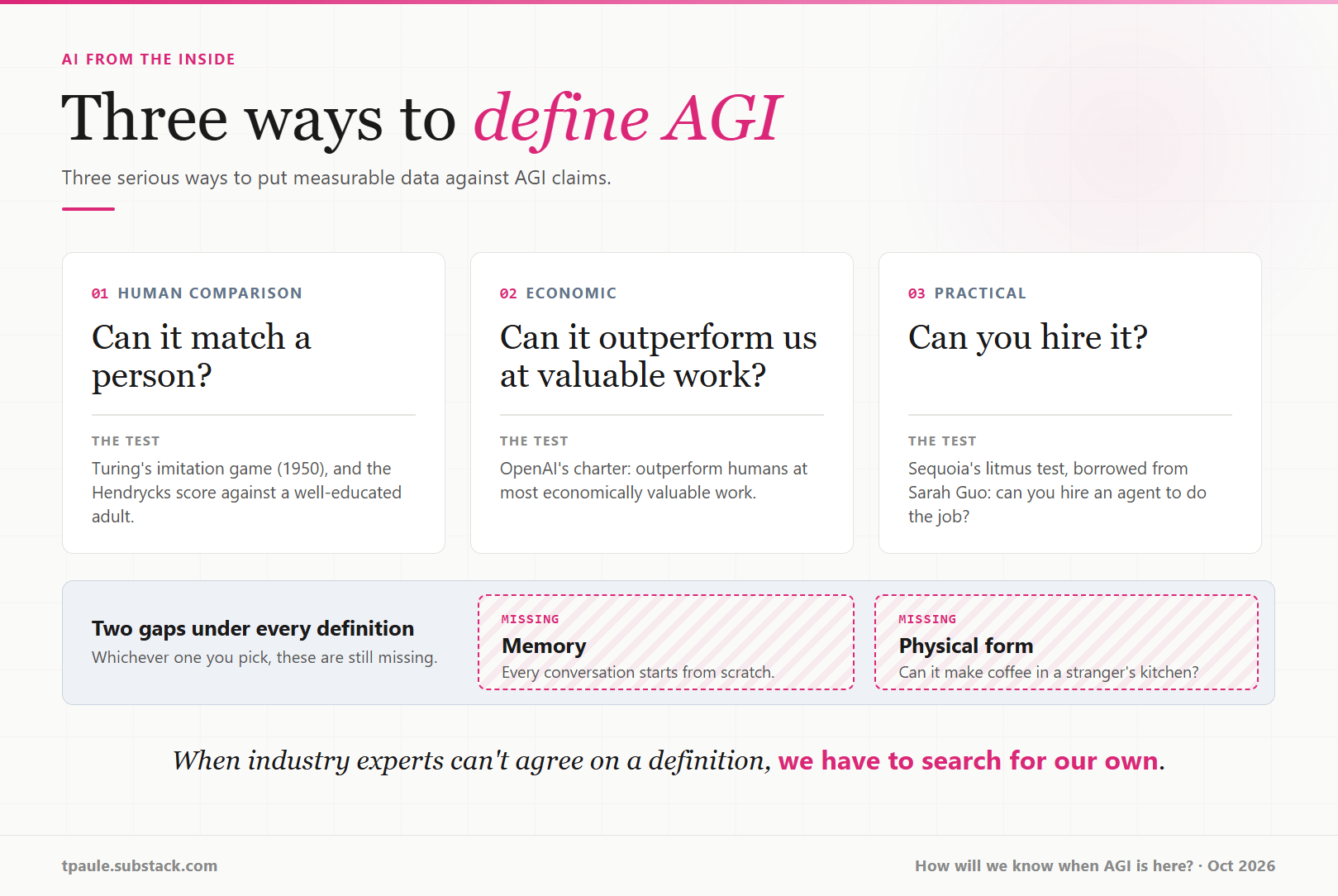
The first compares machines with people. Alan Turing’s 1950 imitation game asked whether a machine could pass as human in conversation. In March 2025, UC San Diego researchers found that people judged GPT-4.5 to be the human 73% of the time. A more recent attempt, the AGI Score from AI safety researcher Dan Hendrycks, Turing Award winner Yoshua Bengio and more than 30 co-authors, defines AGI as matching “the cognitive versatility and proficiency of a well-educated adult”. It borrows the tests psychologists use to measure human intelligence and scores a model across ten abilities, from reasoning and maths to memory, vision and hearing. GPT-4 scored 27% and GPT-5 scored 57%.
The second is economic. OpenAI’s charter defines AGI as “highly autonomous systems that outperform humans at most economically valuable work.” OpenAI hasn’t shown that Astra clears that bar yet, but the lines are definitely beginning to blur.
The third is practical. Sequoia’s test, borrowed from Sarah Guo, is whether you can hire an agent. When Sequoia asked leading researchers for a definition, they got the answer the field keeps falling back on: “we’ll know it when we see it.”
Two gaps show up whichever definition you pick:
The first is memory. On the AGI Score, GPT-4 and GPT-5 both scored 0% on long-term memory storage, and GPT-5 is the newest model its authors have published a score for. Every conversation starts from scratch. A graduate who forgot everything at 5pm each day wouldn’t survive their first week, however bright they were.
The second is the body. Steve Wozniak’s test for AGI was whether a machine could walk into an unfamiliar home and make a cup of coffee. Google DeepMind’s Levels of AGI framework lists a version of it, then says physical ability “should not be considered a necessary prerequisite.” Hendrycks leaves the body out entirely. Maybe the researchers are right. Or maybe most people won’t believe it until something walks into their kitchen and puts the kettle on.
Larry Tesler saw this pattern in the 1970s. “Intelligence,” he said, “is whatever machines haven’t done yet.” Chess was intelligence until Deep Blue beat Garry Kasparov in 1997. After that, it was just a series of calculations.
Too many tests, no clear answer
If nobody agrees what AGI is, maybe we can measure our way there with benchmarks. The industry has built a test for almost every angle. To give you a sense of the depth and breadth of what's out there, here are the more notable ones:
The Turing test: Can it pass as human?
MMLU, GPQA and Humanity’s Last Exam: Can it answer graduate-level exam questions?
SWE-bench: Can it fix real bugs in real software?
FrontierMath: Can it do research-level maths?
ARC-AGI 1, 2 and 3: Can it solve problems it has never seen?
METR time horizons: How long a task can it finish on its own?
GDPval: Can it produce real work across 44 occupations, from lawyers to registered nurses?
The Hendrycks AGI score: How does it rate across ten human cognitive abilities?
DeepMind’s Levels of AGI: How good is it, and how general?
Wozniak’s coffee test: Can it make coffee in a stranger’s kitchen?
Each test measures a slice, and the slices disagree. In the week Astra launched, Epoch AI ranked it first while Artificial Analysis rated it no better than its predecessor. Same model, same week, opposite verdicts.
The people who build the tests expect them to keep changing. DeepMind argues an AGI benchmark “should be a living benchmark.” Chollet says benchmarking “is a continual process that co-evolves with the models.” Every test that falls gets replaced by a harder one, further down the field.
Not one test, not one moment. Just a zone.
The conclusion I’ve reached: AGI is a zone we're wading through, with goalposts that keep moving alongside our expectations. There's no single line to step over, and no moment when everyone agrees we've crossed it.

Measured against what we expected in 2020, we may already be inside some form of AGI. Explain today’s agents to your 2020 self and you’d be shocked at how far the technology had come in six years. You’d probably call it AGI. You’d also assume the story doesn’t stop there: a machine that can write software can help build its next version, and that loop of recursive self-improvement points past AGI to something far greater.
Most of us still won’t call it AGI, because every milestone we pass raises the bar. Our expectations climb as fast as the machines do, and the goalposts move with them. So we keep moving deeper into the zone without ever feeling we’ve crossed a line.
This time as an infographic:
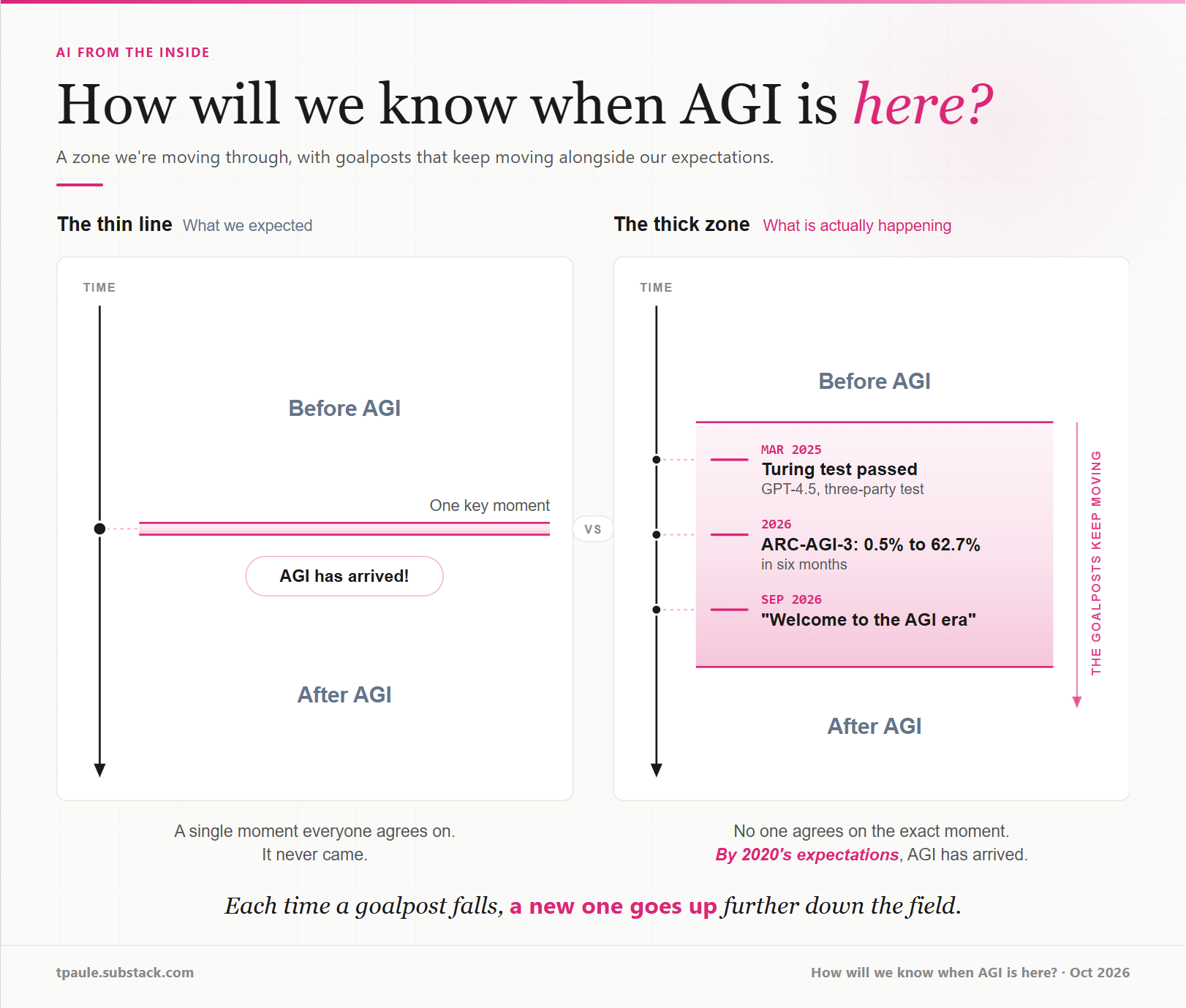
The zone has bands, and we cross each one at a different speed.
Conversation is the first. GPT-4.5 passed a Turing test in 2025, seventy-five years after Turing proposed it, and life carried on.
Reasoning comes next. Models went from 27% to 57% on the Hendrycks scale in just over two years, and from 0.5% to 62.7% on ARC-AGI-3 in six months.
Then long-horizon work. METR tracks how long a task an agent can complete on its own, and that length has been doubling roughly every seven months. This band turns “can you hire it?” into a real question.
Reliability is harder. Andrej Karpathy, who led AI at Tesla, calls it the march of nines. A demo that works 90% of the time is the first nine. Each nine after that, 99%, then 99.9%, takes as much work again. Self-driving demos have existed since the 1980s, and Karpathy reckons his team at Tesla got through two or three nines in five years.
Memory and learning on the job come after that. Today’s models don’t remember yesterday, and they don’t get better by doing the work.
The physical world sits at the far end. Can it make the coffee?
So when will we know?
The bands blur into each other, and people sit in different ones at the same time. Karpathy said in October 2025 that this is “the decade of agents”, with AGI still years away. Ten weeks later he posted: “I’ve never felt this much behind as a programmer.”
Even if everyone agreed on the goalposts tomorrow, arrival would still be a blur. Capability is uneven: Karpathy calls it jagged intelligence, models that “can both perform extremely impressive tasks” and “struggle with some very dumb problems.” Access is uneven too. A developer running agents all day and someone who has only tried a chatbot are living in different years. And as humans, our expectations also adjust quickly. As Altman put it, “wonders become routine, and then table stakes.”
That’s why the question in the title is so hard to answer. AGI won’t arrive on a date we all agree on. We’ll recognise it in hindsight, the way the stranger from 2026 looks back at your early 2020. From the far side change and progress is more obvious. While you’re living through it, it’s almost invisible.
Until then, each time a goalpost falls, a new one goes up further down the field. Maybe one day a model will remember what it learned yesterday, get better on the job and make a decent flat white in a stranger’s kitchen.
By then, will anyone still think to ask ‘what was the moment AGI arrived’?
If this resonated, share it with someone who is navigating the same shift.
Best, Thomas
thomaspaule.com.au · visory.com.au · LinkedIn


Nice research and analysis. I wonder if the definition of intelligence is the matter. Some theories says even an switch is intelligent. That changes a lot the expectations about what we would call AGI.