

Burn the Boats
AI won't kill your business model. Blindly defending it will.

Most leaders try to keep their options open. Hernán Cortés set his on fire.
It was 1519. A young Spanish commander had crossed the Atlantic with around five hundred soldiers and landed on the shores of the New World, on what is now the coast of Mexico. Behind him stood eleven ships. Before him lay an empire vast, unknown, and powerful beyond imagination. He had sailed in open defiance of the governor of Cuba, who had revoked his charter the moment he left port. Home would not welcome him back.
The land he hoped to conquer, the Aztec Empire, had millions of subjects. The reports drifting back from inland scouts told of cities larger than any his men had seen, armies that had never been beaten, and gods who demanded human hearts.
Naturally, Cortés’ men were afraid. Few of them expected to see Spain again. Fear has a way of whispering ‘go back.’ Cortés had been observing them, and he understood that the only way to get them to conquer this land was to take away their option of going back.
So he gathered his soldiers on the beach and gave them one order. Just three words.
Burn the boats.
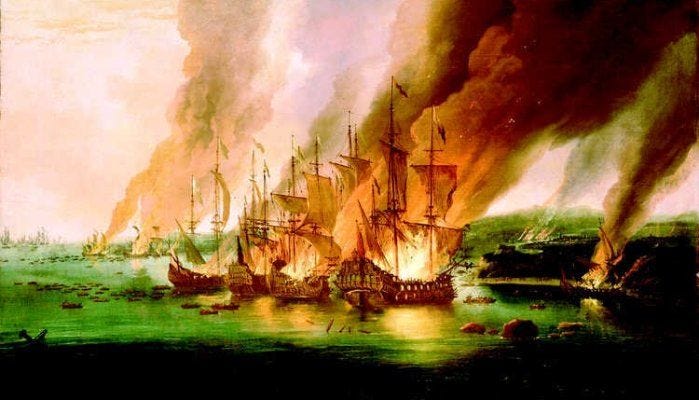
At first, they thought he had gone mad. The ships were the only way home. But as the flames rose and the masts fell into the sea, the message became clear. There was no retreat. Victory was the only option. And so they did what conventional wisdom thought impossible and conquered a vast empire.
Every one of us faces moments when fear whispers ‘go back.’ Moments when the future looks uncertain, when the safe thing to do is cling to the boats we know. The promise of AI and its impact on knowledge work is one of those moments. The interesting question is not whether it’s coming, it’s what we do now that it’s arrived.
Would Cortés’s men have crossed the mountains and conquered the Aztec Empire if the ships had been left in the harbor, ready to take them home? Every leader in every knowledge work business is now standing on a version of that beach. Once the boats are gone, the only direction is forward.



The boats, in 2026, are the business models.
Per-seat pricing. Billable hours. Annual retainers. Placement fees on filled roles. Asset-based fees. Any legacy revenue model that AI can attack is a boat sitting in the water behind you. They were how you made money in a market that is being rewritten.
Some leaders are already on the beach with a torch in hand. Others are quietly hoping the boats will still be seaworthy when they need them. The rest of this article is about which kind of leader you want to be.
Let’s get into it.
Salesforce is showing the way
I never thought I’d write that header. In my personal experience, monolithic enterprise software companies like Salesforce are amongst the most entrenched, self-interested companies in any market. And yet, the single clearest example of a torch-in-hand leader right now is Marc Benioff, CEO and co-founder of Salesforce.
A few weeks ago, Salesforce announced what it calls Headless 360. This is perhaps the most meaningful announcement in enterprise software in years. Every part of the Salesforce platform, the entire stack from CRM to Slack, has been opened up so that AI agents can use it directly, without a human ever logging in. Benioff’s co-founder said the quiet part out loud at the launch: “Why should you ever log into Salesforce again?”
Read that again. The co-founder of one of the most valuable software companies on earth, the company that defined the modern business application, is asking why anyone should use the user interface his company spent twenty-five years perfecting.
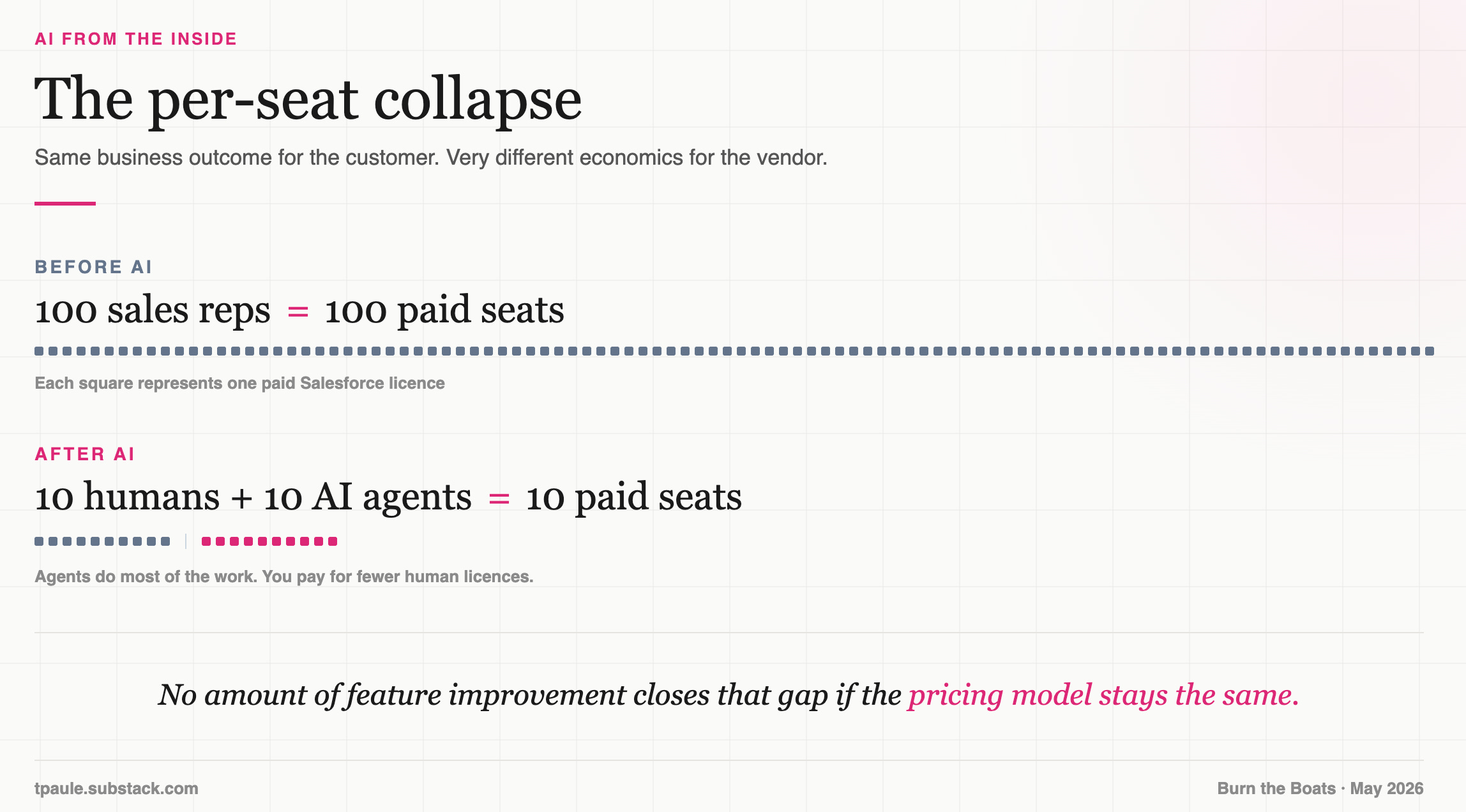
To understand why this is bigger than a product announcement, we need to look at the pricing economics behind it. Jason Lemkin recently summarised the per-seat collapse in a way that has become the accepted framing:
Legacy pricing model: 100 sales reps, 100 Salesforce licenses, roughly $240,000 a year in revenue.
New pricing model: 10 AI agents managed by 10 humans, 10 seats, roughly $24,000 a year in revenue.
Same business outcome for the customer. 90% revenue collapse for the vendor. No amount of feature improvement closes that gap if the pricing model stays the same.
Benioff has effectively decided that Salesforce will lead the collapse rather than be led by it. Headless 360 is a bet that the long-term business is no longer about selling software seats to humans. It is about being the system of record that agents query, the workflow engine that agents trigger, the trust and data layer that everyone else builds on top of. The pricing that comes next will be metered on actions, outcomes, or consumption, not a per-seat license.
This is what burning the boats looks like in 2026. You torch the revenue model that built your company because you can see clearly that defending it is what kills you.
And per-seat SaaS is just the most visible example. The same dynamic is coming for legal billable hours, for advisory retainers, for customer service contracts, for marketing engagements priced by the deliverable, for recruitment placement fees. Anywhere the price is anchored to human time or human-shaped output, the boat is in the water. The companies who burn the legacy models first get to design the next economy. The ones who keep patching the hull will sail it into the rocks.
Buy the ‘Founder Index’
What Benioff just did is not normal CEO behaviour. He looked at a business generating tens of billions in annual revenue, built almost entirely on per-seat licensing, and decided to open the platform to a future where nobody needs to log in. He is actively building the infrastructure to overthrow his own pricing model.
The lesson: only a high-conviction founder archetype does this.
It reminds me of how Reed Hastings at Netflix bet the company on a pivot from mail-order DVDs to online streaming. He saw the future before others, and had the courage of conviction to act on it first, destroying the old business and remaking one anew. There is a wonderful book, No Rules Rules, outlining the Netflix reinvention story in full for those interested.
This is the psychology that separates the leaders who will navigate AI from the ones who will be consumed by it.
To be clear, the frame is not as simple as ‘founder’ versus ‘professional manager’. It is founder mindset versus caretaker mindset. Plenty of founders ossify into defending what they built. Plenty of professional managers operate with founder conviction even when they did not start the company. It is whether you are running this place as if you own it, or as if you are renting it for a few years.
If I had to place a single bet on which companies will survive and thrive in the AI era, I would buy the Founder Index. Not a sector or technology bet, but a leadership bet. Founders, owner-operators, and high-conviction leadership who built the thing with their own hands and are not scared to tear it down and rebuild it for what comes next. These are the people who will burn the boats because they have the conviction, the time horizon, and the psychological permission to do it.
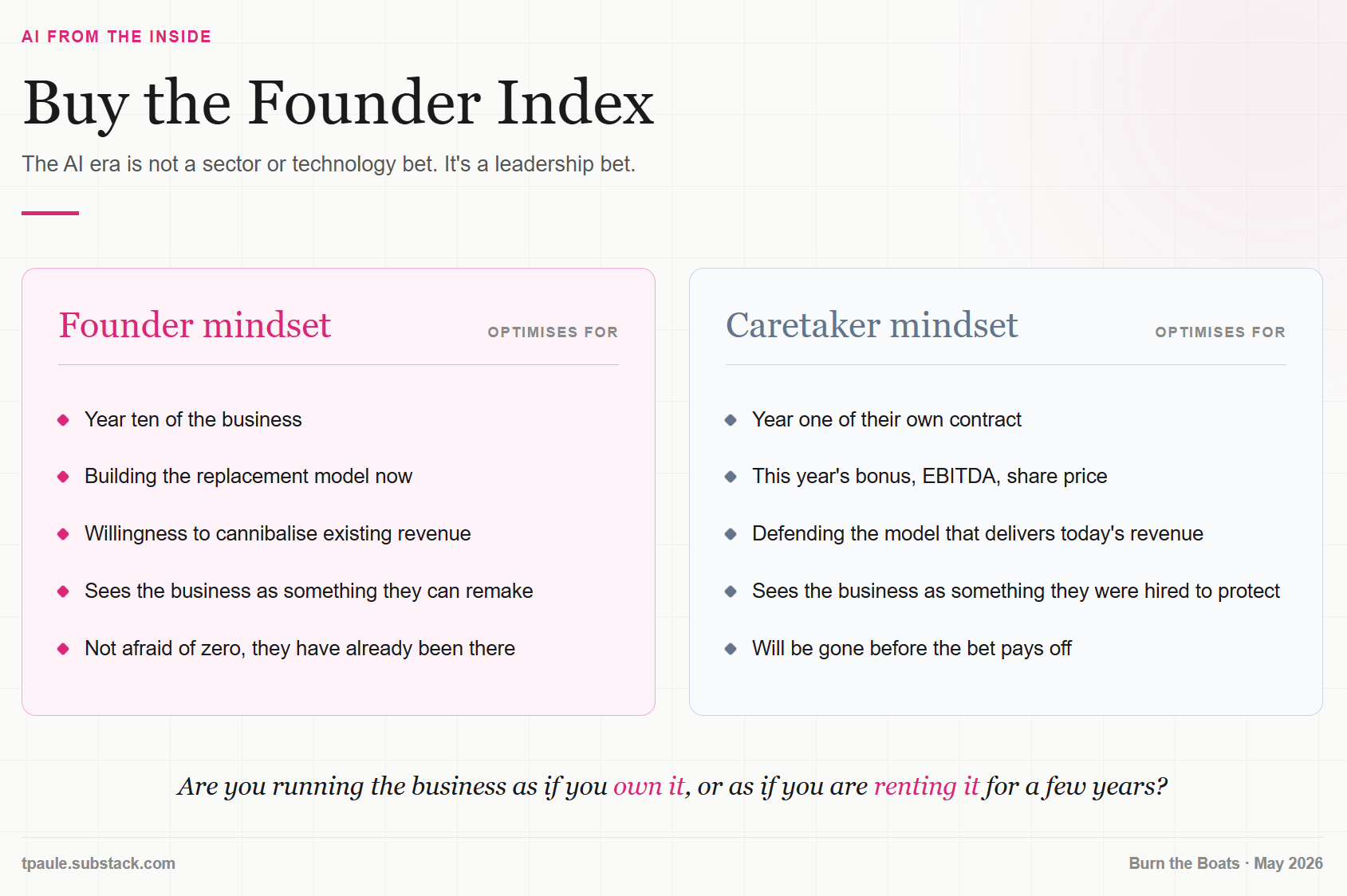
The opposite archetype is the professional management team. The caretaker executive group, two years into a five-year tenure, compensated on this year’s revenue, this year’s EBITDA, this year’s share price. Imagine proposing to that leader that they tear up the pricing model that delivers 80% of revenue. That they kill the product line everyone in the company knows how to sell. That the payoff sits in year five, six, or seven.
The math does not work for them. Their bonus, share price and reputation are tied up in it. They will be gone before the bet pays off. The rational response, given their incentives, is to defend the existing model, bolt some AI features onto it, raise prices a touch, and leave the structural problem to whoever sits in the chair next.
This is why we see so many half-measures. Tollgate fees that charge agents at the door rather than rebuilding the business model for them. AI features priced as upsells on the same old products, not wholesale transformation for a brave new world.
In an uncertain world, we need more people trying to make sure the business they built, or the business they have come to think of as theirs, exists in another ten years.
So, which camp are you in?
Not everyone reading this runs a $35 billion software company like Salesforce. But most people reading this work inside a company that has boats in the water.
The first step is an honest assessment of where you stand. Most businesses right now fall into one of two camps, and the signals are not hard to read if you are willing to look.
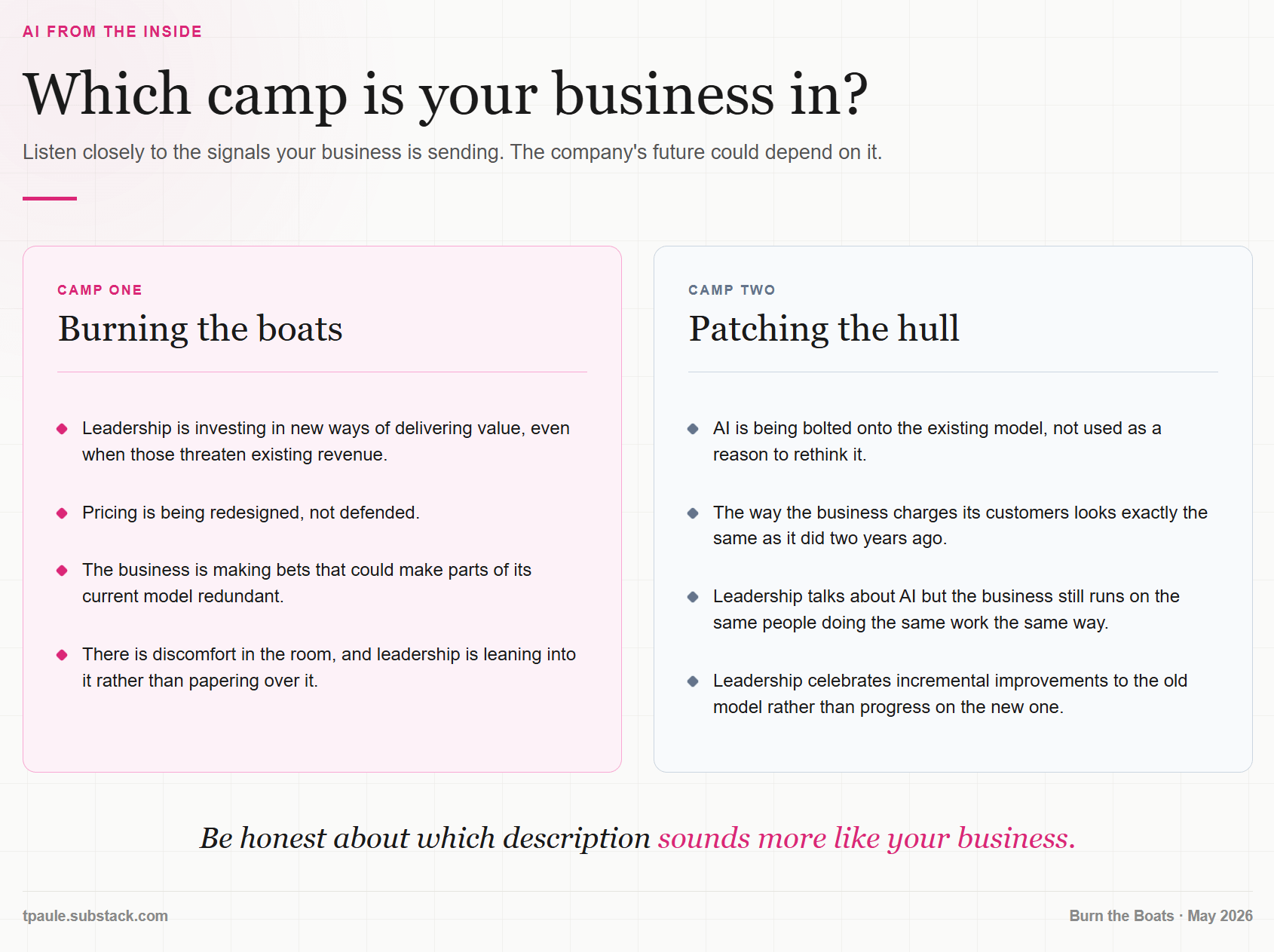
1. Companies that are burning the boats look like this:
Leadership is investing in new ways of delivering value, even when those new ways threaten existing revenue.
Pricing is being redesigned, not defended.
The business is making bets that could make parts of its current model redundant, and leadership is OK with that.
There is discomfort in the room, and leadership is leaning into it rather than papering over it.
2. Companies that are patching the hull look like this:
AI is being treated as a feature to bolt onto the existing model, not a reason to rethink it.
The way the business charges its customers looks exactly the same as it did two years ago.
The language has changed but the operating model has not. Leadership talks about AI but the business still runs on the same number of people doing the same work the same way.
Leadership celebrates incremental improvements to the old model rather than progress on the new one.
Be honest about which description sounds more like your business.
Then have the conversation most leadership teams are avoiding. If you were starting this business today, from scratch, with everything you now know about where AI is heading, would you build it the way it currently works? Which parts would you keep? Which parts would you not recreate?
If you own or run the business, the honest debate around these gaps is yours to close. Nobody else is going to do it for you. The market will not wait while you build a committee to study it. Are you defending the revenue you have, or building the revenue you need for the future?
If you work inside someone else’s business, pay attention to what leadership does, not what they say. What gets celebrated in company meetings tells you what leadership values. What gets quietly shelved tells you what they are afraid of. Listen to whether the conversation is about where the business needs to be in ten years, or about hitting next quarter's numbers. Are you working for a founder or a caretaker? That single distinction will shape your career more than your title, your skills, or your sector over the next five years.
Closing
Most of you reading this already know which parts of your business were built for a world that is changing. You know whether leadership is building for the future or defending the past. The diagnosis was never the hard part.
The hard part is what Cortés understood on that beach five hundred years ago. His men would never fully commit to the conquest while the option of retreat was sitting in the harbour behind them. So he took the option away.
If your boats are still in the harbour, are you prepared to set them alight?
If this resonated, subscribe and share it with someone who is navigating the same shift.
Best, Thomas
thomaspaule.com.au · visory.com.au · LinkedIn

